Overview
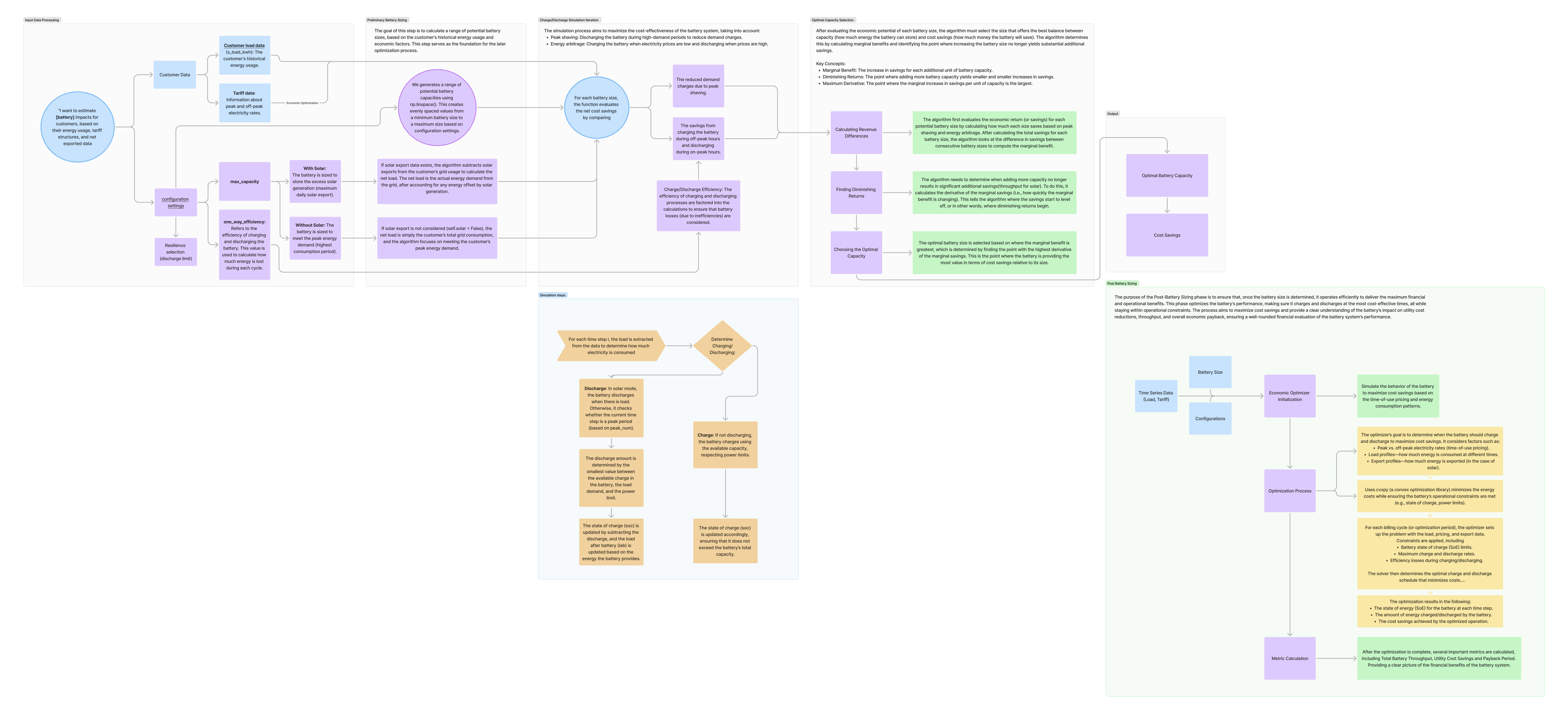
The battery modifier’s goal is aligning resiliency needs with the best utilization of the asset. The algorithm determines the optimal battery capacity for a customer based on their energy usage, tariff structures, and solar generation. The algorithm considers factors like peak shaving, energy arbitrage, and charging/discharging efficiency to maximize cost savings. It calculates the marginal benefit of each battery size and identifies the point where adding more capacity yields diminishing returns. Once the optimal battery size is determined, the algorithm optimizes its charging and discharging schedule to further minimize costs and maximize financial benefits.
Battery Modifier Workflow
Battery Modifier Inputs
-
The model incorporates several inputs to estimate the impact of battery adoption for a specific customer based on their energy usage, rate structures and presence of solar. The user specifies their desired resilience (default 20%) which is also leveraged in the calculation.
Preliminary Battery Sizing
-
The simulation process aims to maximize the cost-effectiveness of the battery system, taking into account:
-
Peak shaving: Discharging the battery during high-demand periods to reduce demand charges.
-
Energy arbitrage: Charging the battery when electricity prices are low and discharging when prices are high.
-
Optimal Capacity Selection
-
After evaluating the economic potential of each battery size, the algorithm must select the size that offers the best balance between capacity (how much energy the battery can store) and cost savings (how much money the battery will save). The algorithm determines this by calculating marginal benefits and identifying the point where increasing the battery size no longer yields substantial additional savings.
-
Key Concepts:
-
Marginal Benefit: The increase in savings for each additional unit of battery capacity.
-
Diminishing Returns: The point where adding more battery capacity yields smaller and smaller increases in savings.
-
Maximum Derivative: The point where the marginal increase in savings per unit of capacity is the largest.
-
Post Battery Sizing
-
The purpose of the Post-Battery Sizing phase is to ensure that, once the battery size is determined, it operates efficiently to deliver the maximum financial and operational benefits. This phase optimizes the battery's performance, making sure it charges and discharges at the most cost-effective times, all while staying within operational constraints. The process aims to maximize cost savings and provide a clear understanding of the battery’s impact on utility cost reductions, throughput, and overall economic payback, ensuring a well-rounded financial evaluation of the battery system's performance.